The Modern Mainframe: A Ready-Made Hybrid? 

The popularity of the Linux platform continues to rise—but does that apply equally to mainframe users? This blog examines the growing hybrid trend in a mainframe context. 

Wait – Linux on a Mainframe? 

Absolutely! Since its inception a generation ago, Linux on IBM Mainframes–such as IBM Z and LinuxONE–has gained significant traction, particularly in enterprise environments.  

By 2006, Linux on IBM Z had already been embraced by over 1,700 customers. Its promise to combine the flexibility of Linux with the reliability and scalability of IBM’s mainframe systems, met with wide acclaim, and organizations adopted it to support a variety of use-cases, including modern applications, cloud computing, databases, and containerized workloads, benefiting from features like advanced data security, high performance, and sustainability.  

For example, the LinuxONE Emperor 4, is popular among financial services organizations such as Citibank, according to sources 

Facilitating Innovation 

More recently, IBM introduced the Integrated Facility for Linux (IFL), a specialized processor designed specifically to run Linux workloads on IBM Z and LinuxONE systems. The IFL provides high server density, reduced operational costs, and

 enhanced performance capabilities, such as Simultaneous Multi-Threading (SMT) and Single Instruction Multiple Data (SIMD) technologies.  

Additionally, IFLs can be added dynamically to systems and support various capacity-on-demand options. That flexibility means organizations use Integrated Facilities for Linux (IFLs) in a cloud computing context to achieve scalability, security, and efficiency. Beyond cloud computing, IFLs are also leveraged – including to house additional development and testing environments: there’s understandable merit in using a flexible, robust and secure environment to simulate critical workloads, to accelerate delivery while keeping vital z/OS cycles devoted to production. 

From an IT sustainability perspective, there are genuine green credentials associated with the platform. According to IBM, running Linux workloads on an IBM z16 single frame or rack mount – instead of on comparable x86 servers in similar conditions – can reduce energy consumption by 75% and space by 67%. Who knew blue was so green? 

Measuring Success  

In 2020, IBM reported “Linux capacity increasing 55 percent year-over-year,” cementing the strategic nature of its investment commitment.  

Industry analyst, Brent Ellis, of Forrester, more recently explained, “[IBM] has a strategy to enable more modern workloads to run on the hardware and the number of people acquiring mainframe hardware to run on Linux is increasing. Over the next few years, it is likely there will be more capability … coming to [mainframe] Linux to ensure a steady and non-disruptive transition to modern environments within the mainframe.”  

Further quantifying that trend, however, is harder than you might expect. While there is plenty of information about the mainframe market – in the form of reports and surveys – details surrounding mainframe Linux are only lightly pencilled in. How Linux supports a modern mainframe-centric strategy is not well-defined, despite the uniformly accepted wisdom of its huge potential.   

To learn more, PopUp Mainframe included a couple of questions about attitudes towards mainframe usage—and specifically Linux environments—as part of the market survey we commissioned this year with research experts Vanson Bourne. We wanted to hear how Linux matters to mainframe decision-makers.  

The survey is still ongoing, so we’re not going to share the numbers yet. But early indications are worth mentioning. Firstly—no great surprise for a mainframe market survey, perhaps—we see an overwhelming loyalty to the mainframe platform, both today and into the foreseeable future.  

What’s perhaps more illuminating, however, is that the initial findings suggest a huge appetite – an overwhelming majority of respondents (we will give you the precise number when the survey is closed) – for using Linux-based mainframe environments in their various forms. Simply put, many who hold the mainframe in high regard see the potential and value of Linux as part of that equation.  

Make the Most of your Modern Mainframe 

Of course, potential is one thing and practical solutions are quite another. Our study therefore also digs into the bottlenecks facing mainframe teams today, and where they most want to improve their capabilities to support the business. 

We look forward to being able to report the full results in the coming weeks – revealing key findings, spotlighting challenges, and offering practical steps towards an even more efficient mainframe environment.  

Update – we are pleased to announce the survey results are now live – visit this page for more details.   

Show and Tell – CEO Insights from PopUp Mainframe

At the GSE UK Conference, Gary Thornhill, founder and CEO of PopUp Mainframe, shared the journey behind his company and how it emerged as a response to the challenges faced during the COVID-19 pandemic. In this interview, he discusses how PopUp Mainframe is revolutionizing mainframe accessibility, addressing industry pain points like environment bottlenecks, skill gaps, and innovation barriers while embracing sustainability and hybrid computing solutions.  

 Show and Tell – CEO Insights from PopUp Mainframe 

Hello, my name is Gary Thornhill, and I am the founder and CEO of PopUp Mainframe. My career has been a bit of a journey. I started out in mainframe operations, which later expanded into middleware. From there, I moved into middleware and led a company that focused on DevOps. The idea for PopUp Mainframe actually came about during the COVID-19 pandemic. At the time, I was the CEO of Sandhata Technologies, a DevOps consultancy. Like many others, we faced the challenge of senior, highly skilled consultants being let go from key client accounts as businesses tightened their budgets. This gave us an opportunity to think differently. One of our clients needed a way to quickly create environments for their work, and we realized there was a broader problem to solve. That’s when PopUp Mainframe was born. It was a solution designed to address the growing need for speed, accessibility, and innovation in mainframe.  

What are some of the current mainframe challenges that PopUp Mainframe addresses?  

The challenges I see in mainframe organizations are often more about the way they’re set up than the technology itself. A lot of organizations still operate with siloed teams, and many rely heavily on outsourcing. This makes it difficult for businesses to innovate quickly. On top of that, mainframes often have static environments—ones that can’t be easily spun up or down—which limits flexibility.  

PopUp Mainframe directly addresses these issues. For example, we allow organizations to create temporary environments in less than ten minutes, whether on-premises or in the cloud. This eliminates the bottleneck of waiting for new environments to be set up. Our platform is also designed to be user-friendly; you don’t need to be an expert in green-screen interfaces to be productive. This accessibility opens up the mainframe to more people, solving both the shortage of environments and the skills gap in the process.  

How has the mainframe evolved, and what role do innovative technologies play in this space?  

When I started in the industry, roles within mainframe teams were very specialized. You’d have one group managing Db2, another handling IMS, and others focused on operations or automation. Today, that has shifted. People are expected to wear multiple hats, often blending mainframe and distributed skills. For example, a developer might now work across mainframe and Linux environments.  

This evolution has been driven in part by initiatives like the Open Mainframe Project, which fosters collaboration and innovation in the community. A great example of this is automated testing. Many organizations are still relying on manual testing, or worse, skipping unit testing altogether. Through PopUp Mainframe, we’ve been working with the Open Mainframe Project to advance frameworks like Galasa, which allows distributed testing tools—such as JUnit or Selenium—to be used on the mainframe.  

This kind of innovation is critical. Automated testing not only speeds up development but also reduces the cost of change, making mainframes more competitive and easier to maintain.  

Do companies without mainframes benefit from adopting the technology? 

It’s a fascinating question. While mainframes are often associated with legacy systems, they’re incredibly relevant in today’s world of big data and high-performance processing. In fact, I’ve seen new clients—organizations that have never used mainframes before—embracing the technology.  

Mainframes are unmatched when it comes to reliability and processing power. Parallel Sysplex, for instance, has been around for 30 years and remains the only true hot failover system. If you have high processing needs, there’s simply no better platform. Plus, mainframes are incredibly sustainable, with the lowest cost per transaction compared to other technologies.  

PopUp Mainframe offers a way for organizations to explore the benefits of mainframe technology without making massive upfront investments. For businesses looking to test new approaches or handle large volumes of data, the mainframe is still the gold standard.  

How does PopUp Mainframe support green tech initiatives?  

PopUp Mainframe supports green tech in a couple of ways. First, our platform is literally “on-demand” and systems can be turned on then turned off when they’re not in use. Traditionally, mainframe environments tend to sit idle, gathering dust and accumulating technical debt. By adopting a “switch it off” mentality, organizations can dramatically reduce energy consumption and optimise their resources. 

On our end, we’ve taken steps to ensure our own operations are as sustainable as possible. For instance, we source data centers with green initiatives like solar-powered servers. It’s a small but meaningful step, and it aligns with our commitment to greener IT practices.  

It’s also worth noting that every digital action has a carbon footprint. Checking your bank balance, for example, uses energy. Most people don’t think about this, but by making IT systems more efficient, we can help reduce the overall environmental impact. PopUp Mainframe is part of the Sustainable IT organization, and we’re pushing for broader changes across the industry.  

What’s the biggest misconception about mainframes?  

The biggest misconception is that mainframes are outdated dinosaurs. In reality, they’re anything but. Mainframes can do just about everything distributed systems can—and often better.  

Take z/OS Connect, for example. It allows mainframes to host web services. Db2 is another great example. It’s an incredibly powerful database, but many organizations aren’t taking full advantage of its capabilities.  

 The issue isn’t with the technology itself but with how it’s perceived. Organizations need to focus on cultural change—encouraging teams to embrace the smart, innovative tools that are already available on the mainframe.  

Can you share one of your clients’ success stories?  

 We’ve had the privilege of working with some incredible clients. One that stands out is a UK insurance company. They’ve completely transformed their developer experience by using PopUp Mainframe. With tools like VS Code and modern CI/CD pipelines, their developers can now work faster and more efficiently. It’s made the mainframe an attractive platform for innovation, especially for cutting-edge work.  

Another client, who runs their mainframe alongside Windows applications in Azure, has seen similar success. Thanks to our partnership with Delphix (Perforce), they can perform end-to-end testing with referential integrity. This level of quality testing has significantly improved their release cycles, allowing them to deliver changes much faster and with greater confidence.  

 What emerging industry trend excites you the most?  

Artificial Intelligence (AI) is incredibly exciting. Tools like Watson Code Assistant and BMC’s Code Insights have the potential to transform how we work. Imagine being able to query vast amounts of documentation and instantly find answers—it’s a game-changer for productivity.  

That said, I think it’s important for organizations to approach AI thoughtfully. There’s a lot of hype right now, and it reminds me of the early days of cloud computing. Companies need to clearly define what they hope to achieve with AI, rather than jumping on the bandwagon. Used correctly, AI can solve significant challenges, but it’s not a one-size-fits-all solution.   

What’s next for PopUp Mainframe?  

We’re incredibly excited about what’s on the horizon for PopUp Mainframe. At the moment, our platform runs on x86 architecture—this includes environments like AWS, Azure, and on-premises virtual machines. But we’re taking things a step further by working on running PopUp Mainframe directly on IBM’s Integrated Facility for Linux (IFL) and LinuxONE.  

This development will be a game-changer, especially for larger enterprises. It means organizations will have the flexibility to deploy PopUp Mainframe either on traditional x86 setups or directly on the physical mainframe. For example, they’ll be able to leverage the agility of Delphix (Perforce) virtualization, which allows for forward and rewind capabilities on multiple PopUp Mainframes. This creates an ideal hybrid scenario, where businesses can experiment with cloud-based solutions while still maintaining the reliability and power of their physical mainframes.  

 In essence, our goal is to offer clients the freedom to operate in a mixed environment, balancing the best of both worlds while keeping their infrastructure modern and adaptable.  

How can PopUp Mainframe solve the industry’s talent challenges?  

The skills gap in the mainframe industry is a pressing concern, and I firmly believe PopUp Mainframe plays a crucial role in addressing this challenge. We’ve already started working with a few North American universities to introduce students to the platform.  

The key lies in making the technology approachable. With PopUp Mainframe, you can do everything you would on a traditional mainframe, but with tools that younger generations are already familiar with—like Eclipse-based GUIs and VS Code. This lowers the learning curve and removes the intimidation factor often associated with mainframes.  

Today’s graduates care deeply about making an impact. They’re less focused on the technology itself and more interested in what it can achieve. PopUp Mainframe aligns with that mindset by allowing them to quickly implement ideas, make code changes, and bring new functionality to life. Imagine telling a young developer they’ll have to wait a week for a Db2 update—they’d be pulling their hair out! By  contrast, our platform enables near-instantaneous changes, which keeps the momentum going and fosters creativity.   

The idea of the “big, scary mainframe” from sci-fi films of the 70s and 80s is outdated. With PopUp Mainframe, we’re helping to reframe that perception and show that mainframes can be just as user-friendly and exciting as any other modern technology.  

What does it take to get started with PopUp Mainframe?  

Getting started with PopUp Mainframe is remarkably straightforward. You can either download our compressed image—now just 60 GB—or access it through Azure. Once downloaded, the setup process takes about ten minutes.  

We’ve also created the PopUp Manual, a detailed guide that walks users through every step of the process. It covers everything from connecting PopUp Mainframe to your physical mainframe to migrating data and configurations.  

The biggest hurdle isn’t the platform itself—it’s navigating organizational processes to gain access to infrastructure. That’s often where delays occur. However, once PopUp Mainframe is up and running, you can hit the ground running.  

Our platform also offers flexibility when it comes to security. For example, in certain scenarios, you can start without full RACF or ACF2 profiles. This allows you to quickly set things up, make changes, and save them to disk. Later, if necessary, you can provide a more secure copy for broader organizational use.  

Ultimately, PopUp Mainframe is just another mainframe—only faster, more agile, and easier to use. It allows teams to utilize their existing skills while bringing in distributed expertise, particularly in areas like testing and automation. It’s the perfect balance of familiarity and innovation.  

This transcript is from an interview with Gary Thornhill, conducted by Planet Mainframe at the GSE Conference 2024. Watch the full interview here. 

Sustainable IT Strategies

Integrating the ESG Imperative 

According to the Global Sustainability Barometer survey – commissioned by Microsoft, conducted by Ecosystem, and released by Kyndryl, “Although 84 percent of organizations consider sustainability goals to be of high strategic importance, only 21 percent actively leverage technology to minimize their environmental impact and guide their broader sustainability strategy.”  

The days are over when technology solutions are purely and simply about helping improve profits and reducing costs; implementing IT initiatives to actively reduce resource usage and emissions is taking its rightful place on today’s strategic agenda. 

Innovating Towards Sustainable IT 

At the arrowhead of using technology to support a more sustainable business model are pioneering organizations and vendors driving the agenda toward a cleaner, responsible, and sustainable business environment

The work of SustainableIT.org in championing and recognizing IT’s vital role in ESG and sustainability imperatives is noteworthy. Their list of award winners reads like a who’s who in sustainable IT innovation.  

PopUp Mainframe was delighted to be among this year’s recipients in recognition of our work in supporting our clients’ ESG and sustainability objectives, as well as our internal efforts towards a cleaner, greener provision of technology.  

As the organizers explained, “In August 2024, after a rigorous judging process, 30 companies were named winners, based on their ambitious ESG goals and measurable results. These winners demonstrated the power of technology to impact not just the environment but also social equity and governance. Key Selection Criteria were:
Ambitious ESG targets & commitment; – Proven impact with clear metrics (e.g., CO2 reduction, cost savings); Leadership in best practices & innovation; Cross-functional collaboration” 

We were delighted to be among the winners of the Environment category award.  

PopUp Mainframe – helping customers deliver On GreenIT objectives 

While each customer case will differ, PopUp Mainframe’s solution offers breakthrough possibilities for an organization’s sustainable IT strategy –  

  • Removing the need for additional infrastructure investment and energy consumption by reusing existing data center or cloud resources 
  • Maximizing energy-efficient mainframe resources and deferring/removing additional energy requirements through efficient scheduling of production workload 
  • Reducing IT’s emissions and energy footprint by only running testing and development environments when needed  

We are actively engaged in supporting our customers’ efforts towards a more sustainable IT provision as part of their operational objectives.  

PopUp Mainframe and Green IT 

PopUp Mainframe provides a sustainable, low-cost, and rapid solution for organizations looking to modernize IT. The solution enables on-demand availability of virtual mainframe environments, dramatically reducing the need for physical hardware and thereby lowering energy and emissions. By enabling mainframe test environments to run in solar-powered cloud data centers, PopUp Mainframe offers mainframe access to anyone who needs it while serving as a catalyst for sustainable transformation.  


See SustainableIT.org’s 2024 Impact Award brochure here.  

Look Back at Tech Field Day at SHARE, Aug 2024

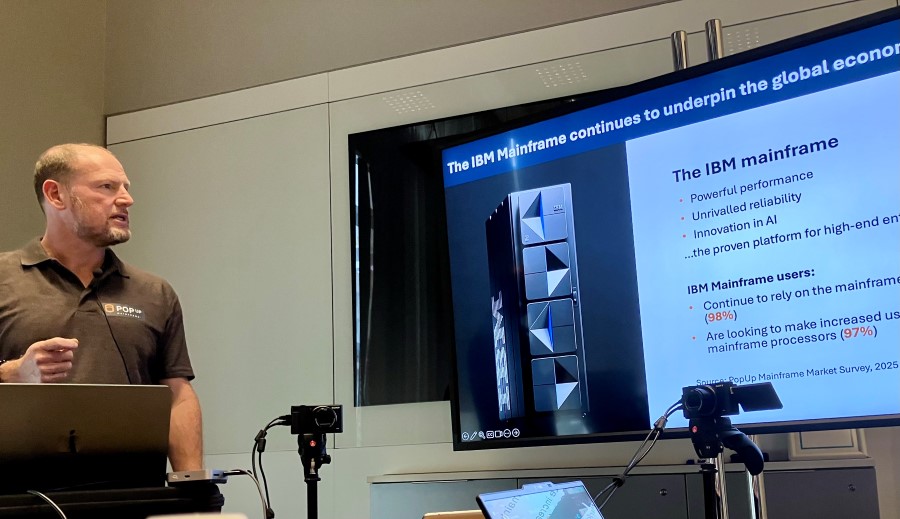
Gary presenting about PopUp Mainframe in front of 8 Tech Field Day delegates

Gary Thornhill, PopUp founder and CEO, had the privilege of presenting a fully featured PopUp demo to a group of mainframe and tech enthusiasts at Tech Field Day at SHARE Kansas City, 2024.

The delegates came from a wide range of backgrounds including appdev, mainframe education, security, DevOps, mainframe services, and Open Mainframe Project.

Gary jumped straight into the session with:

Gary talking

“What is PopUp? Well, we can popup a full mainframe platform in under 10 minutes, in the cloud or on prem.

We are proud that PopUp runs on IBM zD&T under the covers – tried and true industry-leading z/OS virtualisation software.”


Welcome to the Wonderful World of PopUp Mainframe!

Gary presenting at Tech Field Day

PopUp was born out of a direct need to provide customers with mainframe environments so they can action the mainframe transformations they desire.

PopUp is pipeline-ready, and can be fully administered in a distributed way, using APIs to spawn, clone, and tear down a PopUp just like other virtual machines.

Using PopUp to deploy and test code quickly, test the latest security features, meet regulatory requirements, and test upgrades of Z can liberate your teams to achieve their goals more quickly than before.

Gary presenting at Tech Field Day

Modern mainframes are incredibly efficient, cost effective, and provide better per-core performance than the alternatives.* Migrating workloads away from the mainframe requires careful consideration.

Using PopUp to augment your physical mainframe by enabling faster, cheaper testing on ephemeral environments is a fast track to modernising your mainframe processes and continuing to reap the benefits of the physical mainframe.

Gary discussed the key features of PopUp. Some of the call out points are:

  1. We have developed a conveyor belt method to migrate data and config at speed from the physical mainframe to the PopUp, taking care of the SMS challenge.
  2. PopUp provides system and helper utilities. For example, to help automate archiving, and CPU utilisation monitoring to assist in capacity management.
  3. We have extended the Delphix Continuous Compliance engine to enable masking of ANY mainframe data source in a consistent, robust fashion across the entire organisational data estate, maintaining referential integrity across all systems, whether they be mainframe or distributed.


Using PopUp & Delphix for Data masking

PopUp Integrates fully with Delphix to utilise the industry-leading data masking capabilities against mainframe data.

Data can be masked on the physical mainframe, or on the PopUp, depending on your needs. Then we use Delphix Continuous Data self-service portal to provision compliant copies.

“Being able to rewind a full production-like mainframe environment at the touch of a button is absolutely massive for productivity and cutting time-to-market.

Marty McFly would be right at home with the 4D mainframe. Think of it as the ‘undo’ button for a mainframe.”

We have different flavours of PopUp. In this demo we show the PopUp & BMC, which comes with all the BMC DevOps tooling out of the box.


Getting Going with PopUp

Front cover of a book, the Delivery Manual

We know implementing virtual mainframe environments might seem daunting, but don’t panic!

Our Delivery Manual is available to walk you through step-by-step how to get the most out of your PopUp.

We provide full product support with PopUp, and also manage anything to do with IBM zD&T.


Democratising Access to Mainframe

Gary presenting at Tech Field Day

PopUp provides green screen for those who are comfortable with that, but it also enables users with modern IDEs and other tooling.

PopUp users can be productive quickly using their tools of choice, without any approval from the mainframe infrastructure teams or dependence on setup on the physical mainframe.

PopUp is a great way to train people new to the mainframe, as PopUp is a disposable, completely isolated environment with zero risk to the physical mainframe – perfect for training.

“With PopUp everyone is welcome and able to be productive with tools of their choice.”


Use cases on the PopUp are only limited to your imagination

Just some use cases for a dedicated mainframe environment:

  • Gary presenting at Tech Field Day
    Development
  • Use with a desktop IDE
  • All aspects of Testing including Regression testing against mainframe
  • Software evaluation
  • R&D
  • Proof of concept development
  • Offshore or 3rd party environment
  • Training environment
  • Use of a mainframe data “gold copy” on demand across the enterprise
  • Checkpoint, forward and rewind data


What we’ve all been waiting for… the demo!

Slide with text: What you are about to see...


Gary’s demo covered:

  1. Spinning up a PopUp Mainframe in the cloud through the Azure MarketPlace. The PopUp can be ready to go in 6-8 minutes
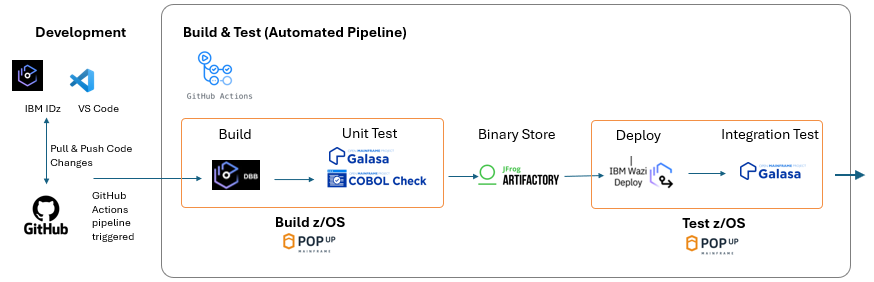
  2. Deploying and configuring an application using a GitHub Actions pipeline (covering tasks which would usually be done by a sysprog, automated testing of the UI through Selenium)
  3. Masking the sensitive data through Delphix Continuous Compliance
  4. Creating the baseline ‘Gold copy’ PopUp containing the masked data and full application
  5. Enabling easy creation of on-demand virtualized PopUp instances with fast, efficient checkpointing
  6. Provisioning compliant dev environment through the Delphix self-service portal
  7. Developer commits code change into Git, pipeline is kicked off to generate, test and deploy the change onto a PopUp, then do UI testing
  8. Failure of automated UI testing
  9. Rewinding the entire PopUp environment back to the previous version (not just the data, the entire app) through the self-service Delphix portal
  10. How a developer can understand what went wrong and fix it without any environment overheads


Some great questions from the audience…

Cameron asked if we need to install DB2. Answer: No, DB2, CICS, MQ, IMS and other apps come out of the box with PopUp and are available in 10 minutes.

Mark asked if there is an option for customers who can’t move unmasked data off the mainframe. Answer: Yes, masking can be done on the physical mainframe, and only the masked data ported onto the PopUp.


Gary talking

“Using PopUp allows organisations to easily start doing DevOps and automation on the mainframe in exactly the same way they do for their distributed applications today.”


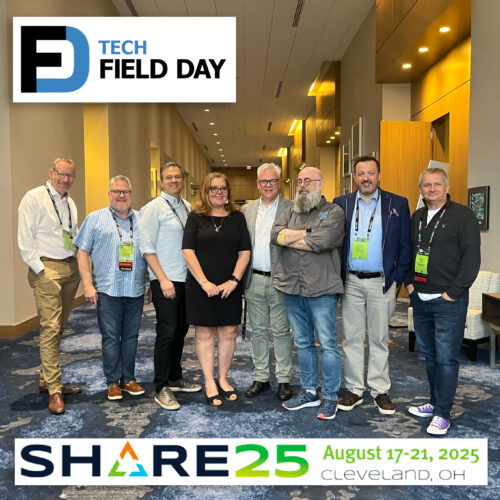
Tech Field Day logo with text: SHARE Kansas City 2024, August 4-8

Thanks to all the fabulous delegates who attended and joined in the conversation with energy and insight.

What a great experience! Thanks to the Tech Field Day team, in particular Stephen Foskett, for running such a great session.


Catch us at the upcoming GSE conference in November at Whittlebury Hall.

Linked in icon Follow us on LinkedIn

Platform Engineering: Building a Mainframe Internal Developer Platform (IDP)

text: platform engineering, building a mainframe internal developer platform

“Platform engineering emerged in response to the increasing complexity of modern software architectures. Today, non-expert end users are often asked to operate an assembly of complicated arcane services,” says Paul Delory, VP Analyst at Gartner. “To help end users, and reduce friction for the valuable work they do, forward-thinking companies have begun to build operating platforms that sit between the end user and the backing services on which they rely.”


Source: gartner.com/en/articles/what-is-platform-engineering

The ultimate goal of platform engineering is to simplify and accelerate software delivery. By eliminating the burden of various tools, dependencies, and access restrictions, developers can zero in on what they excel at – building systems.

Across the industry, Platform Engineering is becoming as important as DevOps. In this blog, we delve into its transformative application within the mainframe space.


Continue reading

PopUp Mainframe & MooodyCow: Partnering for Faster, Cheaper, and Better z/OS Development

The PopUp Mainframe logo and Mooody Cow logo together on a black background
We are thrilled to announce that PopUp Mainframe are partnering with MooodyCow.

MooodyCow are a leading mainframe services provider. Their mainframe specialists cover all areas of mainframe, with a special focus on helping businesses modernise and optimise their mainframe systems.

Our combined vision at PopUp Mainframe and MooodyCow is to deliver cutting edge software and best practice know-how to help organisations achieve their ambitious mainframe optimisation goals.

To find out more, contact us here, or visit the MooodyCow site.


Linked in icon Follow us on LinkedIn

DevOps Excellence Awards 2024

Text: Highly commended DevOps tool/product of the year. Image: PopUp Mainframe logo and computing logo in the corner.

We are very proud to announce that PopUp Mainframe has been awarded Highly Commended in the category ‘DevOps Tool/Product of the Year’ at the DevOps Excellence Awards 2024.


Picture of Gary Thornhill laughing at the awards dinner
Gary Thornhill, PopUp founder, at the awards ceremony

We are thrilled to be recognised alongside some well-established players in the DevOps space.


For many organisations, mainframe is often the last piece to achieve automation. Most businesses have established automation and DevOps ways of working for the distributed teams, but haven’t managed to apply these to the mainframe areas yet.


Adopting DevOps for the mainframe poses some unique challenges. These include a lack of dev and test environments in which to trial automation, new ways of working and new tools, as well as lack of innovation opportunity. Compounding this, there is a skills shortage in mainframe and sometimes resistance to change.


certificate with the text: Highly Commended DevOps Tool/Product of the Year, PopUp MainframeAt PopUp, mainframe modernisation and mainframe DevOps is at the heart of everything we do.

Our mission is to empower mainframe businesses to deliver changes faster, cheaper and better with on-demand environments for dev and test. We see this as a necessary pre-requisite for organisations to move into this final ‘Automation & DevOps frontier’ (where ALL teams, including mainframe, can embrace automation and DevOps practices), and truly achieve their agility aspirations at all levels.


PopUp enables customers to take mainframe on their DevOps journey by creating fully functioning z/OS instances on-demand, on-prem or in the cloud, and controlling them through pipelines. This overcomes dev and test mainframe unavailability – the number one blocker to mainframe DevOps.


PopUp liberates mainframe teams, enabling automation, DevOps innovation and continuous improvement with no risk to the physical mainframe.


PopUp helps fast track DevOps initiatives in the following ways:

  • Aiding the implementation of automation and pipelines (e.g. with BMC tooling pre-installed on a PopUp)
  • Continuously improving ways of working and increasing collaboration
  • Helping to create real, lasting cultural change
  • Increasing productivity by reducing wait times
  • Modern tools boost the productivity of all team members
  • A catalyst for mainframe innovation and fast feedback
  • Ready-made cloud z/OS environments (e.g. Azure)
  • PopUp & Git integration is a cinch
  • Accelerating DevOps journeys with new talent


PopUp also provides additional features to boost your DevOps journey which are not available on the physical mainframe. For example, PopUp can be replicated to create multiple z/OS clones including applications and data, and mainframe instances can be deployed and torn down using APIs or pipelines. In conjunction with Delphix, mainframe instances can be bookmarked at any stage, then they can be rewound or fast forwarded to the snapshot using a self-service portal.


To learn more about how PopUp can help you achieve your DevOps goals, read the blog: Fast Track your DevOps Mainframe Initiatives.


Curious to know more about DevOps for the mainframe, how ephemeral mainframe instances can accelerate your projects, or automating your mainframe processes? Contact us.


Linked in icon Follow us on LinkedIn