Greater Expectations
This year is the 2nd year running in which IT leaders are spending more than before on Modernization initiatives, according to Gartner. And that’s on top of the increasing raft of AI initiatives. Against that backdrop of unprecedented IT investment, it is little wonder that conversations quickly turn towards expected returns.
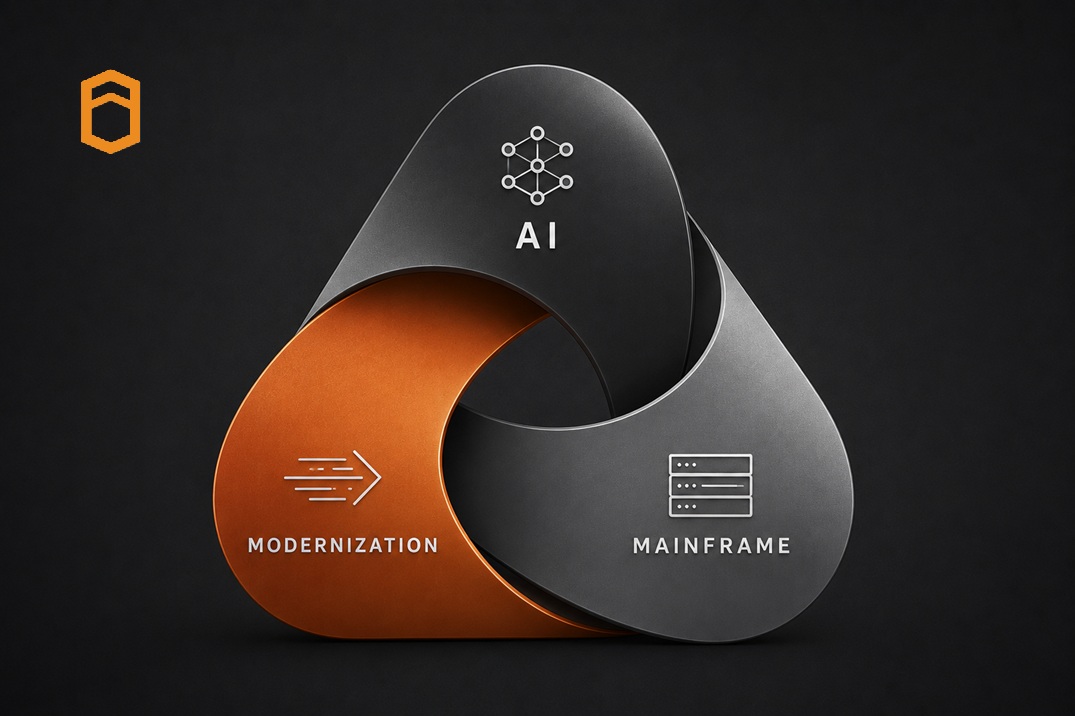
And then there were three
AI is already changing the tone and tempo of mainframe modernization.
Analysts HyperFRAME Research recently stated, “IBM Z and adjacent modernization ecosystems are becoming core components of the enterprise AI stack.” The arrival of AI has widened expectations, accelerated vendor investment, and given enterprise leaders a new set of tools for understanding, testing, documenting, and changing long-established systems.
Yet its value should be framed with discipline. The need to understand why change is required, what should change, and how risk will be controlled, that hasn’t changed. HyperFRAME further advised, “GenAI can compress modernization cycles, but it does not eliminate risk.” Modernization, therefore, should always begin with a clear assessment of business need, operational risk, technical debt, skills continuity, and the value of existing assets.
Careful Which Problem You Try to Solve
Much of the discussion around AI and mainframe modernization focuses today on COBOL application modernization. That focus can be useful, but it often starts from the wrong premise. COBOL is frequently treated as the problem because it is old, rather than because a specific business or engineering issue has been identified. Age alone is not a modernization case.
But that’s not to say AI cannot play a role.
The harder issue is knowledge. Many enterprise COBOL estates have outlasted the careers of those who originally designed them. Over time, applications have accumulated business rules, exceptions, integrations, data dependencies, and operational assumptions that are poorly documented or understood by only a small number of specialists – the predictable consequence of successful systems lasting longer than their creators.
COBOL itself remains a viable enterprise language in 2026. It has modernized, it is supported in contemporary environments, and it continues to serve mission-critical workloads effectively. The real concern is not that COBOL cannot support enterprise computing, but that too few organizations have invested adequately in the skills, documentation, tooling, and engineering practices required to sustain and evolve it. The assertion that modernization must mean COBOL replacement is untrue.
Discovery Precedes Delivery
AI’s most immediate modernization contribution is likely to be in discovery, explanation, and documentation. Enterprise applications contain vast amounts of implicit knowledge. AI can help identify patterns, explain code paths, summarize business logic, map dependencies, assist with documentation, and make unfamiliar systems more accessible. In this respect, AI acts less as a replacement developer and more as an incremental memory layer.
However, enterprise-grade results require enterprise-grade context. A model trained only on general internet knowledge or isolated code fragments cannot reliably understand an organization’s production application estate. Useful modernization intelligence depends on access to institutional, proprietary code, data definitions, job control, test evidence, operational documentation, and platform-specific behaviour. Additional insight from real-time monitoring may offer a more dynamic, situational specificity to the intelligence being captured.
The most credible AI solutions will be those grounded in real mainframe artefacts, genuine customer systems, and deterministic engineering methods that reduce speculation. Modernization necessitates knowing the current state – and AI can potentially achieve that faster.
Planning Fundamentals Remain Unchanged
Even with AI, the fundamentals of planning such as cost, risk, skills, timescale, compliance, operational resilience, and return on investment remain crucial governing considerations. The industry has already seen technology waves in which early enthusiasm ran ahead of delivery maturity. Cloud computing delivered enormous value, but it also exposed hidden cost models and governance gaps. AI may follow a similar path unless enterprise leaders insist on measurable outcomes and controlled adoption.
Modernization program ambitions should be considered carefully, so AI is employed to accelerate specific activities within a well-governed modernization program. It can lower the cost of understanding, and improve the speed and quality of documentation. It can assist with analysis and, vendors claim, conversion. It can generate test assets. It can support developers working on DevOps pipelines. But none of these removes the need for human accountability, architectural judgement, or expert validation.
Testing, the Use Case for all Use Cases
The strongest, most pervasive use case for AI may be testing. Every modernization action requires a corresponding proof that the revised system behaves correctly. Test design, test data creation, execution, comparison, and defect analysis consume a substantial proportion of a modernization program. If AI can materially increase the efficiency of these activities, the business case is compelling.
AI-assisted testing can help generate test scenarios from code and documentation, identify data coverage gaps, create synthetic or masked test data, analyse results, and integrate validation into change pipelines. This is important in mainframe environments where systems of record must preserve behavioural equivalence and where downtime or regression is unacceptable. Testing is a strategic cornerstone for modernization and the mechanism by which proposed change earns permission to proceed. The correct means to execute it efficiently remains vital.
Recent Activities
These PopUp Mainframe articles illustrate practical AI use cases explored in an on-demand virtualized z/OS environment in our lab.
- Mainframe, Meet AI – A Safe Way to Prove Value: Discusses resolving the tension between rigid production environments and dynamic AI experimentation using on-demand sandboxes. It covers internal testing using Claude Code to automate validation workflows.
- AI Adoption in the PopUp Mainframe Lab: Details practical use cases explored in their labs, including identifying PII fields for data privacy, reverse-engineering Db2 tables into visual diagrams, and data migration mapping.
- Harnessing AI for Accelerated Outcomes: Explores how pairing AI innovation with human creativity allows development teams to prototype and build modern software features faster.
- AI on the Mainframe: A PopUp Mainframe Guide to Prompt Engineering: A technical blueprint offering structured frameworks for prompting (Role, Goal, Execution Rules) and strict guidelines on protecting sensitive or proprietary codebase data.
Is AI affecting your modernization plans? If you need to discuss options, let us know.