

We’ve just finished up the season of webinars discussing various aspects of mainframe modernization, thru the most important lens of all – the people who use it every day. Throughout the series, hosted by Planet Mainframe, we and our industry expert guests have spoken about the pressures being faced by mainframe organizations, and looked at market data to help support the conversations.
While looking at a variety of sources of market data, we were lucky enough to also have access to our recent mainframe market survey, conducted on our behalf by Vanson Bourne last year. In an era of diverse digital opinion, market studies are a helpful barometer of insight.
Here to Stay
The right place to start is the overall impression of the IBM mainframe. While most surveys are asking those who already own or use one, who therefore might be more disposed towards it, what is without question is the scale of support and loyalty to the platform.
The overwhelming market impression is of the continued importance and value of the IBM mainframe as the enterprise server for the business. Data points published across a range of surveys – BMC, Arcati, Ensono or PopUp Mainframe – the clear sentiment is continued loyalty and faith in the mainframe. The latest market finding available, from the 2026 BMC study, reported that 94% of respondents are continuing to invest in the IBM mainframe, which echoes our own survey results from last year, which revealed that 98% continue to rely on the mainframe to run the organization.
Here to Change?
What does fall under scrutiny, however, is the requirement to improve how it copes with change. And often the term modernization is used as a catch all term for changing mainframe systems for the better.
In 2025, Gartner reported recently that 7 out of 10 leaders are spending more on modernization than before. The recent BMC report meanwhile said that 40% of respondents saw modernization as a leadership priority in the coming year. From which data points, you could argue, budgets are there to support strategy, suggesting that, when it comes to modernization, there is yet more still to do.
Bottlenecks – The Bare Facts
Look at these statistics:
- 96% experience development and testing challenges using the IBM mainframe
- 88% have concerns over the availability of mainframe environments (34% with a “critical” need)
- Nearly a third have 4 or more separate teams involved in a standard mainframe delivery
- Staffing limitations and poor tooling (79%) are hindrances to meeting business objectives
(Source: Vanson Bourne / PopUp Mainframe, 2025)
As the list above illustrates, mainframe change is beset by a range of operational bottlenecks, as discovered in our survey last year.
One major issue as you can see on the screen here is that mainframe teams are hampered by the lack of a mainframe environment. Amazingly, over a third of respondents expressed a critical need for more z/OS access.
Equally relevant across a variety of mainframe teams, 79% of respondents reported that inadequate tooling and skills challenges were undermining business progress. So that’s 8 out of 10 worried the skills aren’t good enough, or the tooling, and a third in critical need of more environments.
And if that’s not worrying enough, the same mainframe professionals admitted in 96% of cases – basically a unanimous verdict – that they had difficulties in the dev and testing process. That’s a massive concern for mainframe development and QA teams.
Strategic Implications
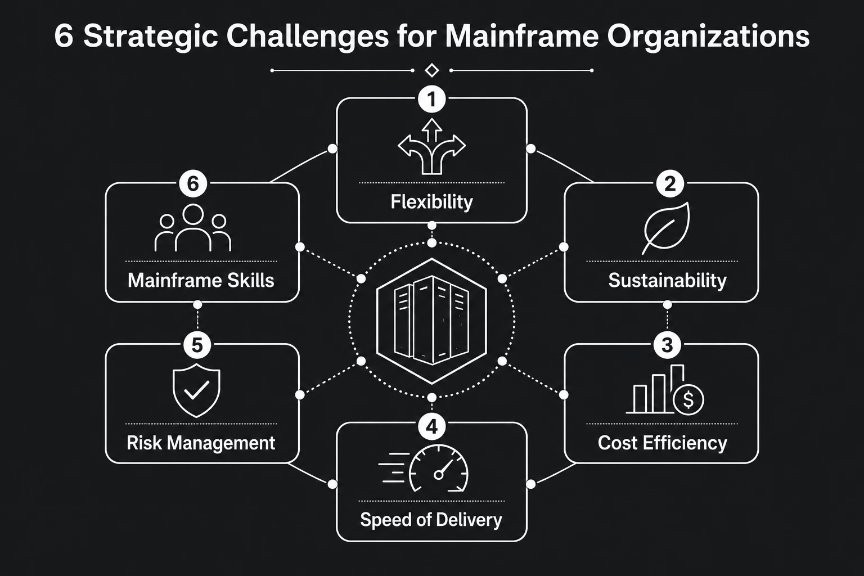
The PopUp / Vanson Bourne study took the time to ask around the topic to see how the reported challenges were affecting strategic goals. In each of these categories below, there was about an 80% response in terms of looking for improvements in each area listed. In other words, fundamental strategic challenges remained when it comes to making change on the mainframe, across speed of change, cost management, flexibility, and beyond.
A balanced approach
While some of those data points are revealing, none of them undermine the mainframe as the enterprise server to run the business. But they all point clearly to a desire to accelerate the pace of change to support business strategy, and find ways to resolve access, the mainframe SDLC process, tooling, and skills issues.
In each case, we believe there is a genuine solution. We see the IBM mainframe as a powerhouse of enterprise computing and, using innovative technology (such as our product) we also believe we can help revolutionize mainframe delivery. Our technology has helped clients accelerate by orders of magnitude already. Learn more at www.popup-mainframe.com
Further Reading
- The final webinar in the accelerating mainframe efficiency series is here.
- Articles about the sysprog/DBA and training team webinars are here.
- PopUp Mainframe market survey information here.
Other market data sources are freely available online.